What my vet said about my 11-year-old's restless nights — and the surprisingly simple thing that fixed it.

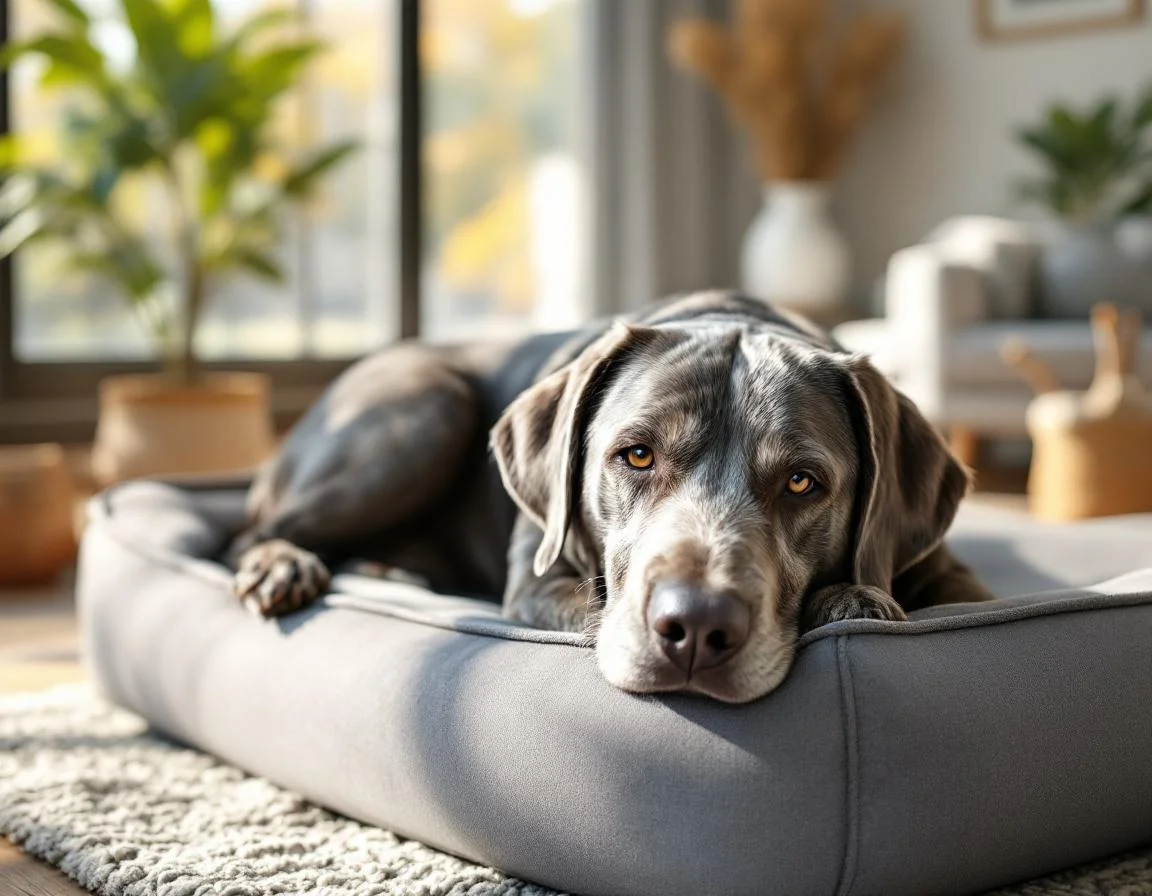
My yellow lab Beau started getting up in the middle of the night when he was nine. At first it was once a night, then twice, then every few hours. We assumed he needed to go outside more often as he got older. So we got up and let him out. He'd wander into the yard, sniff for a minute, come back inside, and then circle his bed for what felt like ten minutes before settling back down — only to repeat the whole sequence two hours later.
This went on for almost two years. We tried everything we could think of. New food. More exercise during the day. Less exercise during the day. Lavender spray on his bed. A second bed in a quieter room. A heated bed in the winter. A "calming chew" supplement my sister recommended. A more expensive calming chew supplement the internet recommended. We took him to our regular vet twice. Both times the vet said his bloodwork looked good and his joints, while showing some early arthritis, weren't bad enough to explain the behavior.
The $700 specialist visit
By summer, sleep deprivation had taken over our household. We finally booked a specialist appointment — a veterinary internal medicine consult that cost $700 between the visit and additional bloodwork. The vet, who was wonderful, ran her hands over Beau for ten minutes, watched him move around the exam room, and asked us about a hundred questions about his daily routine.
Then she said: "Tell me about his bed."
I described it. A nice quilted bed from a national pet chain, about three years old, with poly-fill stuffing and a foam-pellet base. She asked how long Beau spent on it during the day. I said most of the afternoon. She asked if he ever moved off it to the tile floor in the kitchen. I said yes, actually — almost every afternoon, he'd leave the bed and lie on the cool tile for an hour or two, then come back.
She nodded slowly. "He's overheating on the bed and his hips hurt from the floor. That's the cycle."
Older dogs lose the ability to thermoregulate efficiently — they overheat more easily, especially when their body is in prolonged contact with insulating materials like foam or fabric. A standard memory foam bed, the kind sold for "orthopedic support," actually traps body heat. The dog moves off the bed to cool down, then off the hard floor to relieve the joint pain, then back to the bed when the joints scream louder than the heat, and so on.
What she actually recommended
The specialist explained that for senior dogs with even mild joint issues, the bed needs to do two things at once: provide pressure relief (memory foam or similar dense support) and dissipate body heat (which standard memory foam doesn't do). She listed three or four cooling orthopedic beds she said she'd recommended to other patients. We wrote them all down.
I went home and looked at the prices. A vet-grade cooling orthopedic bed in Beau's size was going to run between $130 and $250. After spending $700 on the consultation plus the two years of less-rigorous solutions (the various supplements, the heated bed, the multiple second beds, the lavender spray), my husband and I had clearly spent enough money to buy any of them ten times over.
We picked one of the brands she'd mentioned — a smaller company called Tundra Hound — partly because their Large was the cheapest at $129, and partly because they offered a 100-night trial that meant we could send it back if Beau didn't take to it. The bed arrived three days later, vacuum-packed in a way that made me briefly wonder if I'd been scammed, and then expanded over the next twelve hours into a substantial Large-sized rectangle.
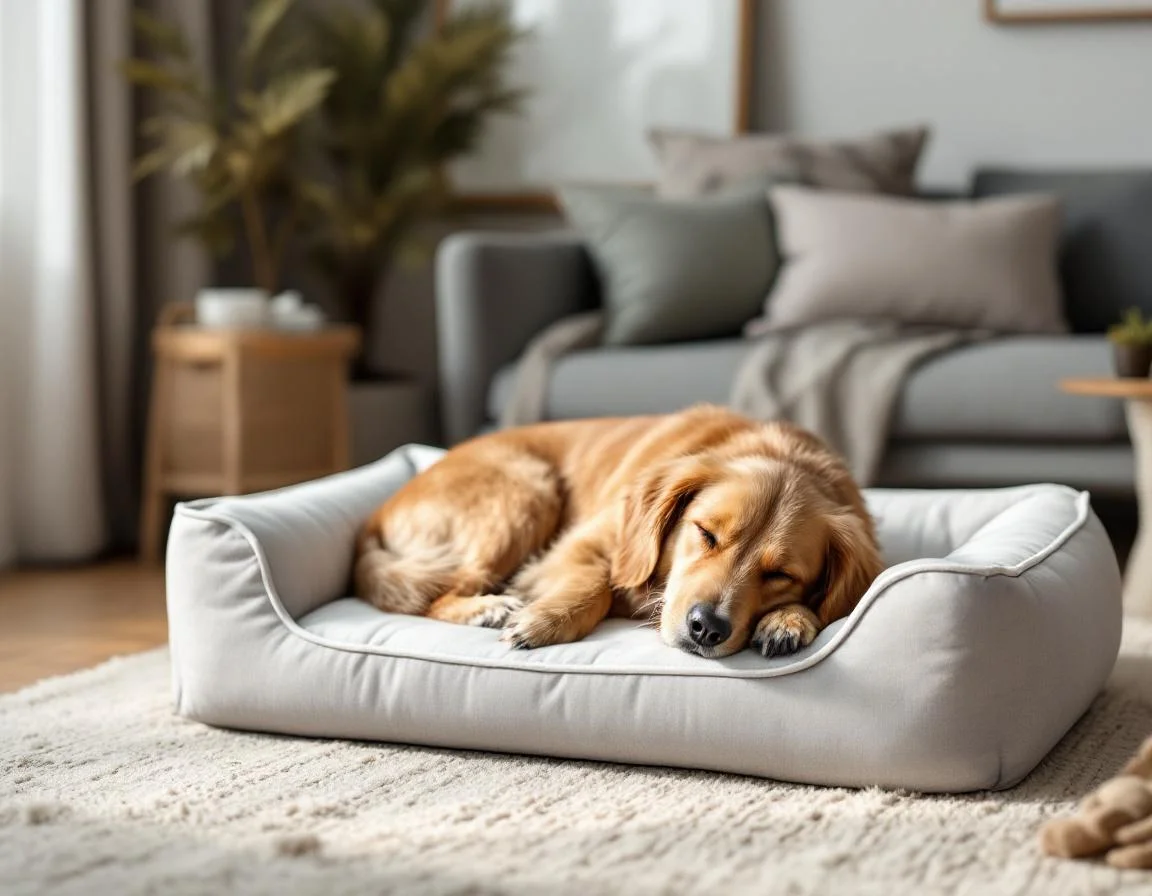
Beau slept on it the first night. He slept on it the second night. By the end of the first week, he was sleeping through the night for the first time in two years. By the end of the second week, the cool tile floor in the kitchen had been demoted to a place where he goes only when he's about to throw up (which is a separate issue we are dealing with).
The cool tile floor in the kitchen has been demoted to a place where he goes only when he's about to throw up. That, it turns out, was the problem all along.
The two things I wish someone had told me
The first is that "orthopedic" and "cooling" are different things, and most beds marketed as orthopedic are actually fairly hot for the dog sleeping on them. The cheap orthopedic beds at the pet chain — the ones with the "memory foam" label — are usually just thicker stuffing or a thin foam layer over polyester filler. The thicker, denser memory foam in the more expensive beds works for the joints but creates a heat-trap problem most senior-dog owners don't know to look for.
The second is that panting at night, restless circling, and seeking out cool surfaces are all signs of being too warm, not just signs of old age. They can also be signs of pain, anxiety, or many other things — please don't replace your vet with a blog post. But if you've ruled out the medical stuff and your dog is still doing this, the bed is worth examining before another $200 in supplements.
The cooling orthopedic dog bed we ended up with.
Memory foam base for joint support, gel-infused cooling layer that pulls heat away from the dog's body, waterproof inner liner (for the realities of senior dogs), washable cover. Three sizes from Medium to X-Large, $89-169 with the current spring sale. 100-night trial, free shipping, no need to ship it back if it doesn't work — they'll donate it.
See Tundra Hound →A few honest caveats
I'm not a vet. Beau is one dog. What worked for him might not be the answer for your dog — though, if you've been chasing the same restless-senior-dog problem we were chasing, the bed is one of the cheaper experiments you can run before more aggressive interventions.
I'd also note that the Tundra Hound isn't magic. It's a well-made bed with a sensible design that addresses a problem most "orthopedic" beds don't address. It's also not the only bed that does this — the specialist gave us three other brand names, and any of them would probably have produced a similar result. I'm writing about Tundra Hound because that's the one we picked, the company asked me to write up our experience, and I had a positive enough experience to want to put it in writing.
Beau is asleep on it right now, eight feet from me as I write this. He looks deeply content. He hasn't gotten up since I sat down at the desk three hours ago. The previous version of his life involved getting up four to six times a night. I don't think I'll ever be able to look at $129 the same way again — that's roughly what we used to spend on supplements every quarter trying to fix a problem the bed solved on its own.
Full disclosureThis article is a paid advertorial produced in partnership with Tundra Hound, and contains links to the sponsor's commerce site. Tundra Hound did not have copy approval prior to publication. The author is describing the experience of a single dog (Beau) and should not be interpreted as a clinical claim about the product's effect on other animals. Individual results vary by breed, age, weight, prior medical history, and many other factors. Any references to veterinary diagnoses or recommendations reflect a specific consultation and are not general veterinary advice — please consult your own veterinarian for any concerns about your pet's sleep, joint health, or behavior. Pricing and product details are current as of publication and may change.